Mollera d'Escalarre: watch birds by the water
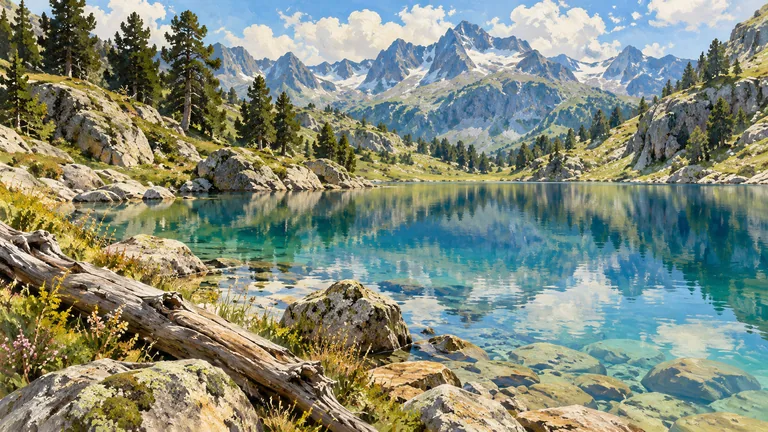
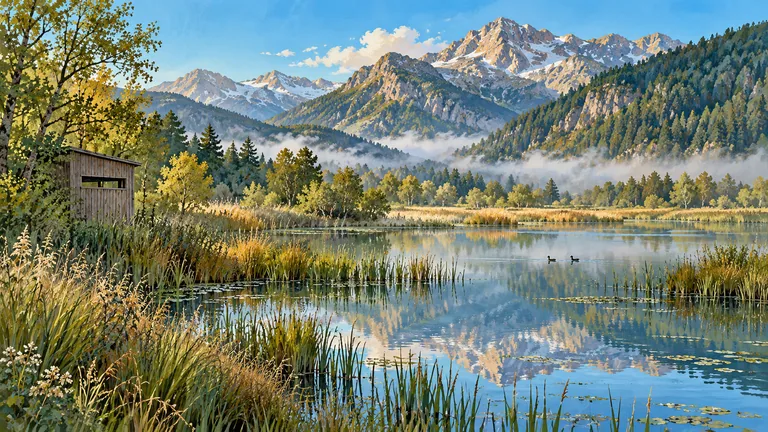
In La Guingueta d?neu, Mollera d’Escalarre offers a first contact with the observation of waterfowl. The Alt Pirineu Natural Park highlights this wetland for its observatories and for the interest of migratory crossings. See the Official map of the Mollera to choose a suitable access and route.
Come slowly to the point of observation, lower your voice and wait. The map cites birds like royal anogue, cormorant and zampullin; seeing a specific species is never guaranteed. To begin with, you see behaviors: which dives, which remains on the shore and which moves in a group. That attention is more valuable than trying to complete a list in a hurry.
Choose the observatory before you walk
The Park directory distinguish the elevated tower of the Mollera and the observatories of the Llobatera and Pla. Use the map to choose one, locate the access and calculate the return. You don't have to go all: stopping in one place for a while usually allows you to observe more behavior than walking continuously.
The Observation Tower helps to understand the bucket of Esterri d’Àneu and the whole of the wetland. It is a different landscape perspective of looking through the openings of an observatory at a lower height. Choose the one who interests the group and check access if someone has difficulty with stairs.
The landscape changes, birds too
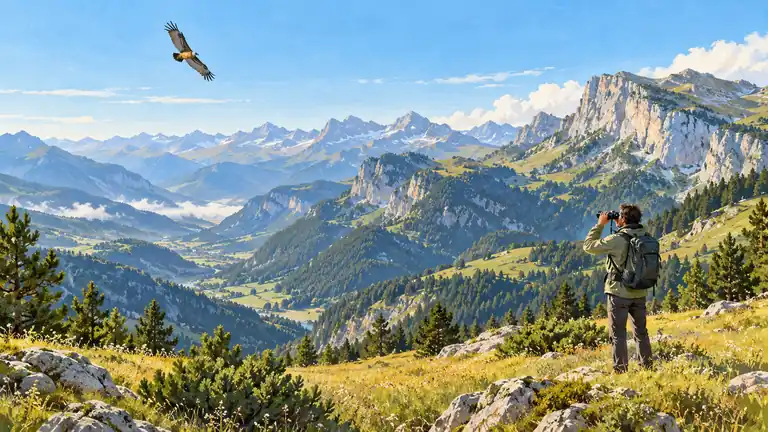
The Bird catalogue of the park It helps to understand the relationship between each species and its habitat. A wetland, a forest and a high mountainside do not offer the same opportunities. In the information of observation of fauna Rave like bonebreakers and forest birds like black stingers appear.
He chooses an environment and devotes time to recognizing it. An ornithological day does not require accumulating a slope: an observatory or an Enabled viewpoint They can work better than a long walk. If you are interested in sensitive species, hire a professional who knows the restrictions and keeps the distance. Avoid looking for nests, canteen or shelters on your own.
Mammals in freedom: also observe the footprints
The park houses mountain mammals and forest, including rebling, deer, deer, wild boars and brown bear, according to its information of fauna. This describes the biodiversity of the territory; it does not mean that they can be seen on any walk or that there is an appropriate place to approach them.
Finding a signal can be as interesting as seeing the animal. A footprint, a rest of food or a mark on the ground raises questions about who was there and how it moves. Photo Untouched, leave the remains where they are and watch from the road. To identify indications, the company of a guide provides context and avoids hasty conclusions.
Pla de Son: an activity to learn how to interpret traces
Monthing Pyrenees program an activity of traces of fauna which combines observation of the environment and interpretive work. It's an option to learn what to look at and how to read signals, especially if you prefer to start with accompaniment. Consult recommended age, dates and reservation on the activity page.
This departure should be distinguished from a visit to a wildlife centre. Animals housed in a centre are under human care; that experience is not a sighting at large. Choose the proposal you're really looking for and check what it includes. To see free fauna, any responsible professional will talk about possibilities, conditions and respect, never of an assured appearance.
Good photographs, quiet animals
SEO/BirdLife remember that the welfare of birds and habitat conservation should guide observation. His code of ethics It addresses problems such as claims, nest approaches and photographic baits. Use binoes or zoom; if an animal changes its behavior through Your presence, it increases the distance.
- He speaks low, stays in the places allowed and avoids chasing a framing.
- Don't play songs to attract birds or offer food.
- Do not publish precise nesting locations or sensitive shelters.
- It leaves room for other observers and shares the point of observation with discretion.
The best photo is compatible with the animal continuing its activity.
How to get around a territory with wildlife
The recommendations of the Generalitat to live with large carnivores They include carrying dogs tied, not leaving food, following the roads and avoiding approaching scars or following traces of these animals. If you see a bear from afar, keep your distance. If it's close, keep calm, don't run and slowly leave a free way out of the animal.
With any mammal, avoid placing yourself between a mother and her young, touching specimens apparently alone or blocking her passage. The forest is also a livestock workspace: respect herds and closures. Before you leave, check the time and the route; to stop you to look, choose a point where the group can be safe.
A simple plan from WinTuWin
Prepares binoculars, water, a coat layer and a notebook. Choose a short visit to the Mollera to start or a guided activity if you want to deepen. With children, he proposes three small challenges: listening to a sound, recognizing a way to move and drawing something observed. You don't have to identify everything.
Then you can complete the day with a nearby village and return to the apartment to check the photos. Write down date, environment and behavior, even when you don't know the name of the species. Each outlet adds a new way to know the landscape, without turning nature into a programmed show.
What a naturalistic exit fits with your group
| Your curiosity | A good first choice | On which to look at |
|---|---|---|
| Birds by the water | An observatory of the Mollera | Form of swimming, diving and feeding |
| Understand the landscape | Tower or viewpoint enabled | Relationship between water, vegetation and mountain |
| Learning about mammals | Guided trail activity in the Pla de Son | Indications and interpretation, without chasing animals |
| Photograph of nature | Specialized outing with guide | Distance, light and unaltered behaviour |
Prepare a small field notebook with three columns: place, the observed and questions. Upon returning to the apartment you can consult a guide to try to identify birds or traces, leaving as unknown what is not clearly seen. The observation is also enjoyed when it ends with a question for the next departure.
A day outdoors. Your own space to come back to.
Plan the outing at your own pace and choose an apartment that suits your group. At WinTuWin, coming home is part of what makes those days together special.
Book direct for the best rate.Sources and consultations to prepare for the visit
Revised information on 22 October 2026. Check the conditions, openings and reservations in force on the pages of each agency or service. Activities are organized separately from accommodation.
See the 11 sources consulted
- Map of the Mollera d'Escalarre
- Birds of the Natural Park of l'Alt Pirineu
- Observation of fauna in the park
- Fauna of the park
- Official watchers
- MonthNature: traces of fauna
- SEO/BirdLife: responsible observation
- SEO/BirdLife: code of ethics
- Generalitat: coexistence with large carnivores
- Alt Pirineu - viewpoints and observatories
- Explore the Parc . tower of the Mollera